Seminar: AI Basics for Everyday Life

Seminar: AI Basics for Everyday Life
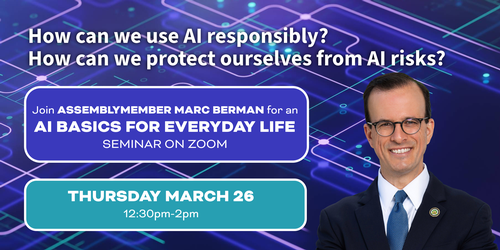
In today's world, understanding AI isn't just for people who work in tech — it's a skill all of us need. Just like learning to read, write, or use the internet, AI literacy empowers you to make informed decisions, spot misinformation, and navigate daily life with confidence. The more you know, the more in control you are.Join Assemblymember Marc Berman for an AI Basics for Everyday Life Seminar to hear from a panel of experts on how artificial intelligence is shaping our daily lives and how you can use it safely and confidently. Whether you're curious about AI assistants, keen to understand what AI can and cannot do, or simply want to understand what all the buzz is about, this seminar is designed with you in mind.
Topics Will Include:
- What AI is (and what it isn't).
- How AI shows up in everyday tools and apps.
- Staying safe and smart in an AI-powered world.
Panelists:
Peter Norvig, Distinguished Education Fellow, Stanford Institute for Human-Centered AI
- Peter Norvig previously directed Google’s core search algorithms group and Google’s research group. He was head of NASA Ames’ computational sciences division, where he was NASA’s senior computer scientist and a recipient of NASA’s Exceptional Achievement Award in 2001. He has taught at the University of Southern California, Stanford University, and UC Berkeley, from which he received a PhD in 1986 and the distinguished alumni award in 2006. He has authored a wide range of publications, which include Artificial Intelligence: A Modern Approach, the leading textbook in the field.
- Susan Meister is an advocate and former journalist, focused on the increasing danger of disinformation in the media, on the internet, and in the rise of AI-generated images. In 2024, she founded the California Media Literacy Coalition to advance youth and adult media literacy education through both public events and the creation of "MisinfoDay," a day to connect students with experts in media literacy and empower them to make informed decisions about what to believe online.
Date and Time
Thursday Mar 26, 2026
12:30 PM - 2:00 PM PDT
Location
Zoom (Link provided upon RSVP.)
Fees/Admission
This event is free and open to all.
RSVP Here
Website
Contact Information
(650) 324-0224

